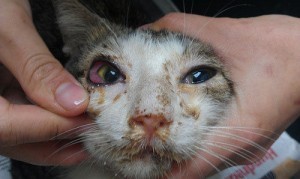
Most people who have worked with cats have seen cats with runny, pusy eyes and noses, sneezing and sometimes being quite unwell. This is ‘cat flu’ (picture 1). 80% of cases are caused by either Feline Calicivirus (FCV) or Feline Herpesvirus (FHV) or both together. Cats with poor immune function will be more seriously affected and possibly die, e.g. cats with FIV or FeLV, elderly or malnourished cats, or kittens with low natural immunity against the viruses.
(See ‘Glossary’ for abbreviations or words in red for definition)
Transmission
Both FCV and FHV are passed on from infected cats in their saliva, snot and sneezes. FCV can survive in a dry environment for a month so cats can pick it up from the environment.
Picture 1: Typical appearance of a cat with signs of ‘flu’ (courtesy of Rebecca Cordwell)
Symptoms
Both viruses cause the typical ‘cat flu’ signs of upper respiratory tract infection and fever, occasionally leading to pneumonia.
FHV can cause corneal ulcers, and can result in chronic rhinitis (those cats that just keep on sneezing). Eye infections in young kittens can cause particular damage ranging from a fairly minor, cosmetic problem to completely obscuring the eye.
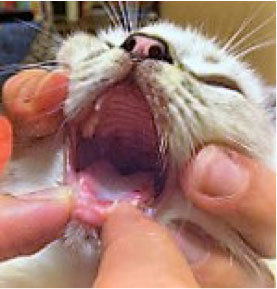
FCV often causes ulcerations in the mouth (picture 2). It can also cause ‘limping syndrome’, and chronic gingivostomatitis.
Then what happens?
Generally, symptoms usually resolve spontaneously within 1-2 weeks, but cats can still shed virus for about 1 month. After this, some cats will fully clear the viruses, others will remain persistently infected, sometimes with no symptoms but still shedding the viruses. They can also suffer relapsing symptoms. Secondary infections with various bacteria and other organisms can complicate the picture.
How can cat flu be treated?
Treatment is mostly supportive, helping the cat to recover. This may include:-
Antibiotics – against secondary infections; given as injections, tablets +/- eye treatments.
Anti-herpesvirus medications for severe or refractory cases (eg non-healing eye ulcers) – oral tablets (famcyclovir) and various eye treatments.
Pain killers (anti-inflammatories) only if the patient is well-hydrated.
Mucolytics (drugs to loosen up mucus).
Appetite stimulants.
Nursing care for those that can be handled; this includes providing a warm, quiet, stress-free environment; cleaning eye and nose discharges; steam vapour to help unblock their noses (do NOT use Olbas Oil or Menthol); and encouragement to eat and drink – using warm, strong-smelling foods, and possibly hand-feeding or syringing food and water.
Picture 2: Ulcers visible along edge of tongue (courtesy of Helen Gunn)
Prevention
Vaccinating cats certainly helps. The ‘flu’ vaccines are a combination of FHV and FCV. Vaccination is not 100% effective, particularly FCV vaccines. (Please see website for further information in extended article).
Isolation of affected cats within a household or shelter from non-affected cats, can help prevent transmission.
Cleaning with products that will kill FCV is important as it lasts 30 days in a dry environment, and is not killed by all disinfectants. Suitable cleaning solutions are sodium hypochlorite (5% bleach, diluted to a 1 in 32 dilution – rinse off thoroughly after use!), potassium peroxymonosulphate (eg Virkon S), chlorine dioxide, or other specific anti-virus disinfectants.
Sneeze barriers – solid glass or plastic – are better than metal cages at a shelter or cattery.
NEUTERING free-roaming cats helps prevent the spread of all transmissible diseases, as they are less inclined to wander and are generally healthier cats. Feeders looking after colonies of cats can help too, by regularly washing food and water bowls, and providing nutritious food.
Glossary
Chronic rhinitis – inflammation of the nasal passages persisting for more than a few days Chronic gingivistomatitis – inflammation of the gums and soft tissues of the mouth persisting for more than a few days. FeLV – Feline Leukaemia Virus FIV – Feline Immunodeficiency Virus
Most people who have worked with cats have seen cats with runny, pusy eyes and noses, sneezing and sometimes being quite unwell. This is ‘cat flu’ (picture 1). Despite a short name it is a complex disease process as it is not caused by just one bug. 80% of cases are caused by either Feline Calicivirus (FCV) or Feline Herpesvirus (FHV) or both together. Then there are a whole host of other infectious agents that can ‘jump on the band-wagon’ taking advantage of the cat’s vulnerable status.
It is extremely common in unvaccinated cats, especially when there are lots of cats together in one place. It has a high morbidity rate (numbers of cats infected that get ill), but a low mortality rate (number of infected cats that die as a result of infection). Cats with poor immune function are more likely to have serious illness and possibly die, e.g. cats that concurrently have FIV or FeLV, elderly or malnourished cats, or kittens with low natural immunity against the viruses.
(See ‘Glossary’ for abbreviations or words in red for definition)
Transmission
Both FCV and FHV are passed on from infected cats in their saliva, snot and sneezes. Thus, close or direct contact is generally required for transmission, via sneezing, mutual grooming, or sharing food and water bowls. However, unlike FHV which only lasts 1-2 days outside a host, FCV can survive in a dry environment for a month and is also resistant to many disinfectants, making it possible for a cat to become infected via fomites, rather than direct contact.
Symptoms
The two viruses can cause some similar symptoms – the typical ‘cat flu’ signs of upper respiratory tract infection and fever, occasionally leading to pneumonia, but they also have their own particular sets of symptoms too.
FHV can cause corneal ulcers, and can result in chronic rhinitis (those cats that just keep on sneezing).
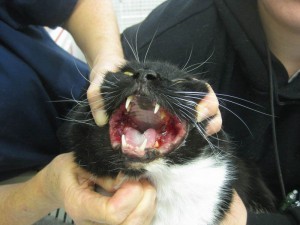
FCV often causes ulcerations in the mouth which can be very painful (picture 2 – author’s own cat Mikey as a kitten). It can also cause ‘limping syndrome’ due to inflamed joints, which is usually short lived. It is also associated with chronic gingivostomatitis, where the gums and soft tissues of the mouth can be incredibly sore and inflamed (picture 3). There have been some outbreaks of ‘Virulent Systemic FCV’ in Europe and USA. This nasty form of FCV infection causes fever, skin swelling, ulcerations of the head and limbs, liver disease, pneumonia, sometimes embolisms, and often death. Fortunately it is not common.
Typical appearance of a cat with signs of ‘flu’ (from http://www.catwelfare.org)
Then what happens?
Outcome of FHV & FCV infection can vary widely. In otherwise healthy cats, symptoms usually resolve spontaneously within 1-2 weeks. FHV can still be shed by the cats, despite recovery, for about 3 weeks, and FCV for about 1 month, possibly longer.
Unfortunately, both viruses can remain in some infected cats for life. These cats (called asymptomatic carriers) may not have any symptoms but still shed the viruses, potentially infecting other cats. They may also suffer relapsing symptoms, especially if they are stressed, or given immune suppressing drugs like steroids.
As well as FHV and FCV, cat flu can be complicated by secondary infections. Commonly, the following bacteria and other organisms are the culprits: Chlamydophila felis, Mycoplasma spp., Bordatella bronchiseptica, and Pasteurella multocida. Chlamydophila felis is worth special mention, as it is not killed by the antibiotics that are usually given. It causes conjunctivitis, often with very puffy eyelids, and requires special treatment preferably with doxycycline orally for 4 weeks, plus tetracycline based eye ointment. Using eye drops/ointment alone will not fully clear the infection.
Ulcers visible along edge of tongue (H. Gunn)
How can cat flu be treated?
Although antibiotics are usually given to cat flu cats, these are only to help with the secondary infections, they do not kill the viruses. There are some anti-herpesvirus treatments available, which can be useful for severe cases or refractory cases such as non-healing eye ulcers. Oral famcyclovir can be given, and anti-herpes eye ointments are available. There are no safe anti-FCV drugs available. So, it’s really down to the cat’s own immune system to fight them off.
Other supportive medicines can be given to help make the cat feel better. Anti-inflammatories (eg meloxicam, ketoprofen, tolfenamic acid) can be used only if the cat is well hydrated, to reduce fever and inflammation. A mucolytic drug (breaks down mucus) called bromhexine (Bisolvon) can help clear the thick snot. Appetite stimulants (mirtazapine, cyproheptadine) are useful if the cat is very inappetent, and multivitamin supplements can be given too.
There have been some other treatments suggested for FHV and FCV infections, some have been put through clinical trials, others have not, but none have been shown to be significantly effective. These include Feline Interferon Omega (Virbagen Omega), Human Interferon Alpha, and L-Lysine (for FHV).
The crux of treating cats with flu however (those that can be handled), is good old fashioned Tender Loving Care. Cleaning the eye and nose discharges will make them feel so much better, keeping them in a warm, quiet environment away from other stresses – such as dogs or lots of noise and commotion, will help speed their recovery.
As cats’ appetites are heavily dependent on their sense of smell, being all bunged up tends to lead to inappetence. Therefore, steam vapour can help unblock the airways – provide a bowl of steaming hot water near the patient (ensuring it cannot be knocked over) several times a day. Nebulisers used for babies can also be used. Please do NOT use Olbas Oil or Menthol– cats are very sensitive to these substances – they can irritate and burn their delicate eyes and noses.
Use particularly smelly foods and warm it up a bit to create a strong aroma. There are not many cats out there who can’t resist some warmed sardines in tomato sauce (oddly they do seem to prefer the ones in tomato sauce over the ones in just oil!). Encouraging cats to eat by finger-feeding, or even syringe feeding liquid food may be necessary. It is really important they get nutrition on board, to have the strength to get better. Also, if cats starve completely for as little as a few days they can go into a form of liver failure called hepatic lipidosis.
Supportive fluid therapy is equally important. Some severely debilitated cats should ideally go on a drip at a vets, but if this is not possible, syringing water and electrolyte solutions orally is important.
Gingivostomatitis affects the soft tissues of the gums and mouth (from felinevet.net)
Prevention
Vaccinating cats certainly helps. The ‘flu’ vaccines are a combination of FHV and FCV. Generally, kittens, or cats that have not been vaccinated before, require a course of 2 injections, given 3-4 weeks apart, then importantly, a booster 1 year later. Kittens are usually started from 8-9 weeks of age. After that, re-vaccination frequency depends on their risk of infection – outdoor cats should be boosted annually, totally indoor cats can be done once every 3 years. Vaccination is not 100% effective, particularly the FCV vaccines, as the virus changes itself frequently, thus can evade the normal immune system responses.
In kittens, any antibodies against the viruses that they received from their mother’s milk (maternally derived antibodies – ‘MDA’) can interfere with the vaccinations. Unfortunately, how long MDA last in each kitten’s body varies widely, from as little as 4 weeks up to 16 weeks. Thus, there could be a 4-week window where the kitten has no protection before its vaccinated (hence why we often seen kittens develop cat flu around 4-6 weeks – usually infected by their own mothers). Conversely, it may have MDA interfering with both of its kitten jabs given at 8 and 12 weeks, leaving it unprotected thereafter.
To attempt to combat this in high risk situations, it is possible to start vaccinations from 4 weeks of age and give repeated vaccinations every 3-4 weeks until 16 weeks of age. Although this obviously increases the cost of vaccination, lots of shelters now do this protocol, as the benefit of reducing outbreaks of flu outweighs this cost. Veterinarians involved with vaccinating cats in this manner must be aware of the different types of vaccine, and what types are safe to use like this. This is classed as ‘off-label’ use of the vaccines, meaning the manufacturers have not licensed them to be used in this way.
There are several scenarios whereby infection can be spread within a household/shelter, and here it is important to remember that asymptomatic carrier status described above.
You have healthy cats and are introducing a new apparently healthy cat into the house. Any of these cats could be asymptomatic carriers, and the other cats may not have adequate immunity. The asymptomatic carrier could be shedding virus, and infect the other cats.
You have healthy cats, and are bringing home a sick cat to nurse it. The sick cat will undoubtedly be shedding virus and your resident cats may not have adequate immunity.
Your resident cat(s) has/have had cat flu recently and you are bringing home a new cat.
You run a shelter for rescued cats with new arrivals coming all the time.
Any of these scenarios can result in spread of infection. Prevention of spread is a 3 pronged system of quarantine, cleaning and vaccination.
Any new ‘healthy’ arrivals should be quarantined for at least 2 weeks, preferably 3, allowing time for infection to manifest itself should it be brewing. During this time, they should be vaccinated as soon as possible. Any cats with signs of cat flu should be isolated away from non-symptomatic cats. Any queens about to kitten, or with young kittens already should be isolated.
Cleaning any cleanable surfaces with products that will kill FCV is important – it lasts 30 days in a dry environment, and is not killed by all disinfectants. Suitable cleaning solutions are sodium hypochlorite (5% bleach, diluted to a 1 in 32 dilution), potassium peroxymonosulphate (eg Virkon S), chlorine dioxide, or other specific anti-virus disinfectants. Follow product guidelines carefully in terms of how to make it up, how long it should remain in contact with surfaces, and if rinsing off is required. If you use household bleach, be sure to rinse this off thoroughly, as cats are very sensitive to it.
Try to prevent spread by personnel – eg at a shelter with multiple staff, keep staff members working in one area only. If it’s just your house- feed, clean and handle healthy animals first, then sort out the sick ones, wash hands between the different groups, and if possible change clothing, or wear overalls kept solely for that group.
Sneeze barriers – solid glass or plastic – are better than metal cages at a shelter or cattery, they prevent transmission by sneezing- a cat’s sneeze can only travel one metre!
These are the ideal standards, and it many circumstances it is just not possible to do all this, but the closer to this the better. The number of cats in a given space, and lack of airflow within that space, are major factors for the spread of cat flu.
Claire Zentveld, BSc., BVM&S, GPCertFelP, MRCVS
Glossary
FIV – Feline Immunodeficiency Virus FeLV – Feline Leukaemia Virus Fomites – Any surface or substance that acts as a means of transmission of disease – includes environmental objects – cages, beds, food/water bowls and personnel – our hands or clothes.
https://care4catsibiza.org/wp-content/uploads/2016/09/Care_4_Cats-1-of-1-25.jpg6671000Care 4 Cats Ibizahttps://care4catsibiza.org/wp-content/uploads/2025/02/c4clogo-300x300.pngCare 4 Cats Ibiza2016-04-10 19:00:502016-04-10 19:00:50What is TNR and how does it work?
A new study in The Veterinary Journal written by Annette L. Litster of Purdue University’s College of Veterinary Medicine’s Department of Veterinary Clinical Sciences presents Lister’s conclusions about FIV positive and negative cats living together based on research of the cohabitation of cats living in separate rescues.
In the one rescue, Litster discovered that FIV was not passed between infected and non-infected cats during normal day to day interaction in a shared living environment. In the second rescue, Lister’s studies also showed that FIV was not transmitted to kittens when their mothers were already infected prior to birth.
The Truth About FIV
FIV, or Feline Immunodeficiency Virus, is a cat-only disease which cannot be transferred to humans or other animals. It is a slow virus that affects the cat’s immune system over a period of years. The infected cat can fight off the infection and become totally immune, can become a carrier that never gets sick, or worst, end up with a compromised immune system.
FIV Transmisson
FIV is not easily passed between cats as it cannot be spread casually through litter boxes, food and water bowls, or snuggling and playing. This disease is transferred when an infected cat bites another cat and breaks the other cat’s skin. This means that a neutered cat in a home is highly unlikely to infect any other cats as long as they are properly introduced or are not particularly aggressive in nature. FIV is much more difficultly transmitted than people are led to believe, and there is often confusion between FIV and FeLV.
FIV Positive & Negative Cats Living Harmoniously
Litster’s studies document FIV positive and negative cats living together harmoniously without the disease being transmitted among the group members, despite sharing all the same bowls, litter boxes, bedding and engaging in mutual grooming and even episodes of mild aggression.
These studies coupled with the further understanding of exactly how FIV is spread demonstrates why it is not valid to assume that FIV positive cats can’t live together with their fellow uninfected feline friends. The vast majority of cats, once neutered, have no desire to bite the other cats they live with. They may play fight, but this rarely leads to a serious bite which is what would be required to inject the virus.
FIV Should Not Mean a Death Sentence
FIV is shrouded in rumor and prejudice, and as a result too many cats are deemed unadoptable and end up being euthanized. These groundbreaking studies by Litster provide evidence that FIV positive kitties are not the great danger to their brethren as we may have once thought them to be.
Hopefully this new research can help veterinarians and shelter staff to advise cat owners and adopters to make better informed decisions and in turn help put an end to FIV positive cats being needlessly killed due to a completely controllable and non threatening illness.
As we go into 2016 my strongest wish is that we won’t have any abandoned babies to raise this year. As much as I love these tiny bundles of joy, I can never give them what their mother can, no human substitute can… and babies belong with their mothers when at all possible. There were numerous litters that were brought in last year that shouldn’t have been… by people that meant well but interfered too soon…
Before you scoop up a litter of “abandoned” kittens, please be SURE the kittens are actually abandoned.
How do you tell? If you find a single kitten wandering on its own or a litter dumped in a box or bag, you should rescue them immediately. They were probably abandoned by an unscrupulous and heartless human. In cases like this they will need urgent care, including keeping them warm and feeding them kitten formula NOT cow’s milk! In an emergency goats milk can be used for a short period of time, it doesn’t provide all the nutrients the kittens need but it won’t give them diarrhea and dehydrate them like cows milk does. Please contact your vet or us for help or instructions on hand raising kittens.
If you find a litter of kittens together in a nest:.. The mother cat may be out looking for food, or may have been scared off by your presence and is hiding very close by waiting for you to leave. She will be VERY upset if you take her kittens and sadly, your effort to “save” them might actually be a death sentence as despite our best efforts there is usually a 15% to 20% loss of life in hand reared kittens.
Clean kittens who are sleeping soundly are probably not abandoned… if the kittens aren’t in imminent danger, wait and observe them from a distance for an hour or two. You can put them in a little box with a soda bottle, or something similar, full of hot water if you’re worried about them being cold. A mother cat will NOT “reject” kittens that have been touched by humans.
You can try scattering flour around the nest and leave the area completely for a while. Look for paw prints in the flour when you come back. If there are signs that mama cat has been back but she is afraid of you and runs away, she is probably feral, meaning she was born outside and has never been around humans, and should stay outside with her kittens.
You should give her as much space as possible and not interfere with her. You can set up some sort of shelter nearby in the hopes that she might use it, and of course she will appreciate a steady source of food and water. Nursing mothers need lots of extra calories, so it’s best to feed dry kitten food if possible.
Kittens should only be removed from their nest if there is no evidence of a mother cat after several hours, or if the kittens seem to be in imminent danger or distress.
Please contact us when the kittens start eating on their own at 6 to 8 weeks old to get the mother cat trapped, neutered and returned to her babies or you will have another litter within a couple of months nd if you have unsterilized pets please have hen sterilized and become part of the solution… not part of the problem.
If you are interested in becoming a foster parent then please contact us with your name and phone number, or alternatively you can apply here… it’s hard work, long hours but incredibly rewarding.
https://care4catsibiza.org/wp-content/uploads/2016/09/maxresdefault-1.jpg7201280Care 4 Cats Ibizahttps://care4catsibiza.org/wp-content/uploads/2025/02/c4clogo-300x300.pngCare 4 Cats Ibiza2016-01-18 12:25:472016-01-18 12:25:47What to do (and NOT do) if you find an abandoned kitten or litter
https://care4catsibiza.org/wp-content/uploads/2016/09/cat-on-a-plane.png351624Care 4 Cats Ibizahttps://care4catsibiza.org/wp-content/uploads/2025/02/c4clogo-300x300.pngCare 4 Cats Ibiza2016-01-17 19:19:422016-01-17 19:19:42Transporting a cat from Ibiza to the UK or Europe
Routine vaccination has greatly reduced the extent of several feline diseases (including some that can prove fatal). It is vital that your cat has all the necessary vaccinations and boosters.
What vaccines does my cat need? Care 4 Cats, as a member of The Cat Group, recommends vaccines for the following feline diseases:
Feline infectious enteritis (FIE) – a vaccination must Feline infectious enteritis (a severe and often fatal gut infection) is caused by the feline parvovirus (or feline panleukopenia virus). Vaccination against FIE has been very successful. Unvaccinated cats are at great risk because the virus is widespread in the environment.
Cat ‘flu’ – a vaccination must Two types of cat ‘flu are vaccinated against feline herpesvirus (FHV-1) and feline calicivirus (FCV). These viruses are very common and vaccination will protect your cat against prolonged illness, but because there are many different strains of cat ‘flu the vaccine will not totally eradicate the threat.
Feline leukaemia virus (FeLV) – a vaccination must for outdoor cats FeLV is a lifelong infection and unfortunately most cats will die within three years of diagnosis, usually from a subsequent disease like leukaemia, lymphoma (tumors) or progressive anaemia. It is not an airborn disease and can only be passed on via direct contact between cats (usually by saliva or bites). Because of the serious nature of the disease, CP recommends FeLV vaccination.
Feline chlamydophilosis – depends on your circumstances This bacterium, which causes conjunctivitis in cats, can’t survive in the atmosphere and is thus spread by direct contact between cats (affecting multi-cat households and kittens predominantly). Your vet will discuss your situation and advise as to whether this vaccine is necessary.
We may request cookies to be set on your device. We use cookies to let us know when you visit our websites, how you interact with us, to enrich your user experience, and to customize your relationship with our website.
Click on the different category headings to find out more. You can also change some of your preferences. Note that blocking some types of cookies may impact your experience on our websites and the services we are able to offer.
Essential Website Cookies
These cookies are strictly necessary to provide you with services available through our website and to use some of its features.
Because these cookies are strictly necessary to deliver the website, you cannot refuse them without impacting how our site functions. You can block or delete them by changing your browser settings and force blocking all cookies on this website.
Google Analytics Cookies
These cookies collect information that is used either in aggregate form to help us understand how our website is being used or how effective our marketing campaigns are, or to help us customize our website and application for you in order to enhance your experience.
If you do not want that we track your visist to our site you can disable tracking in your browser here:
Other external services
We also use different external services like Google Webfonts, Google Maps and external Video providers. Since these providers may collect personal data like your IP address we allow you to block them here. Please be aware that this might heavily reduce the functionality and appearance of our site. Changes will take effect once you reload the page.
Google Webfont Settings:
Google Map Settings:
Vimeo and Youtube video embeds:
Privacy Policy
You can read about our cookies and privacy settings in detail on our Privacy Policy Page.



 FIV is not easily passed between cats as it cannot be spread casually through litter boxes, food and water bowls, or snuggling and playing. This disease is transferred when an infected cat bites another cat and breaks the other cat’s skin. This means that a neutered cat in a home is highly unlikely to infect any other cats as long as they are properly introduced or are not particularly aggressive in nature. FIV is much more difficultly transmitted than people are led to believe, and there is often confusion between FIV and FeLV.
 How do you tell?
 Clean kittens who are sleeping soundly are probably not abandoned… if the kittens aren’t in imminent danger, wait and observe them from a distance for an hour or two. You can put them in a little box with a soda bottle, or something similar, full of hot water if you’re worried about them being cold. A mother cat will NOT “reject” kittens that have been touched by humans.
 You should give her as much space as possible and not interfere with her. You can set up some sort of shelter nearby in the hopes that she might use it, and of course she will appreciate a steady source of food and water. Nursing mothers need lots of extra calories, so it’s best to feed dry kitten food if possible.